
Masterworks Research · June 2026
How the closed-end interval structure trades daily liquidity for access to private assets, what that costs, and where it sits among the routes into illiquid markets.
An interval fund is a closed-end fund, registered with the SEC, that offers to buy back a fixed share of its outstanding assets from investors at regular intervals, usually quarterly, at net asset value (NAV) [1][2]. The rule that governs them, Rule 23c-3 of the Investment Company Act of 1940, lets the fund set that repurchase amount anywhere from 5% to 25% of shares per offer, and most funds choose the floor of 5% per quarter [3]. The structure exists for one reason. It lets a fund hold mostly illiquid assets, things like private credit, real estate, and other private market positions, while still giving everyday investors a periodic exit, which a traditional daily-redemption mutual fund cannot do. For an investor weighing alternatives, the question is whether the access is worth the limited liquidity and the higher fee that comes with it.
What You Need to Know
- The repurchase offer is the whole mechanism. At a set interval, the fund offers to repurchase between 5% and 25% of shares at NAV, with 5% per quarter being the common choice [1][3]. You do not sell on demand. You tender into a window.
- Most investors can buy in, but not all can get out at once. Interval funds registered under the Securities Act of 1933 can be sold broadly, including to non-accredited investors, often at a $1,000 to $25,000 minimum [4]. If a quarter's redemption requests exceed the offer amount, the fund fills them pro rata, so you may recover only part of what you asked for [1].
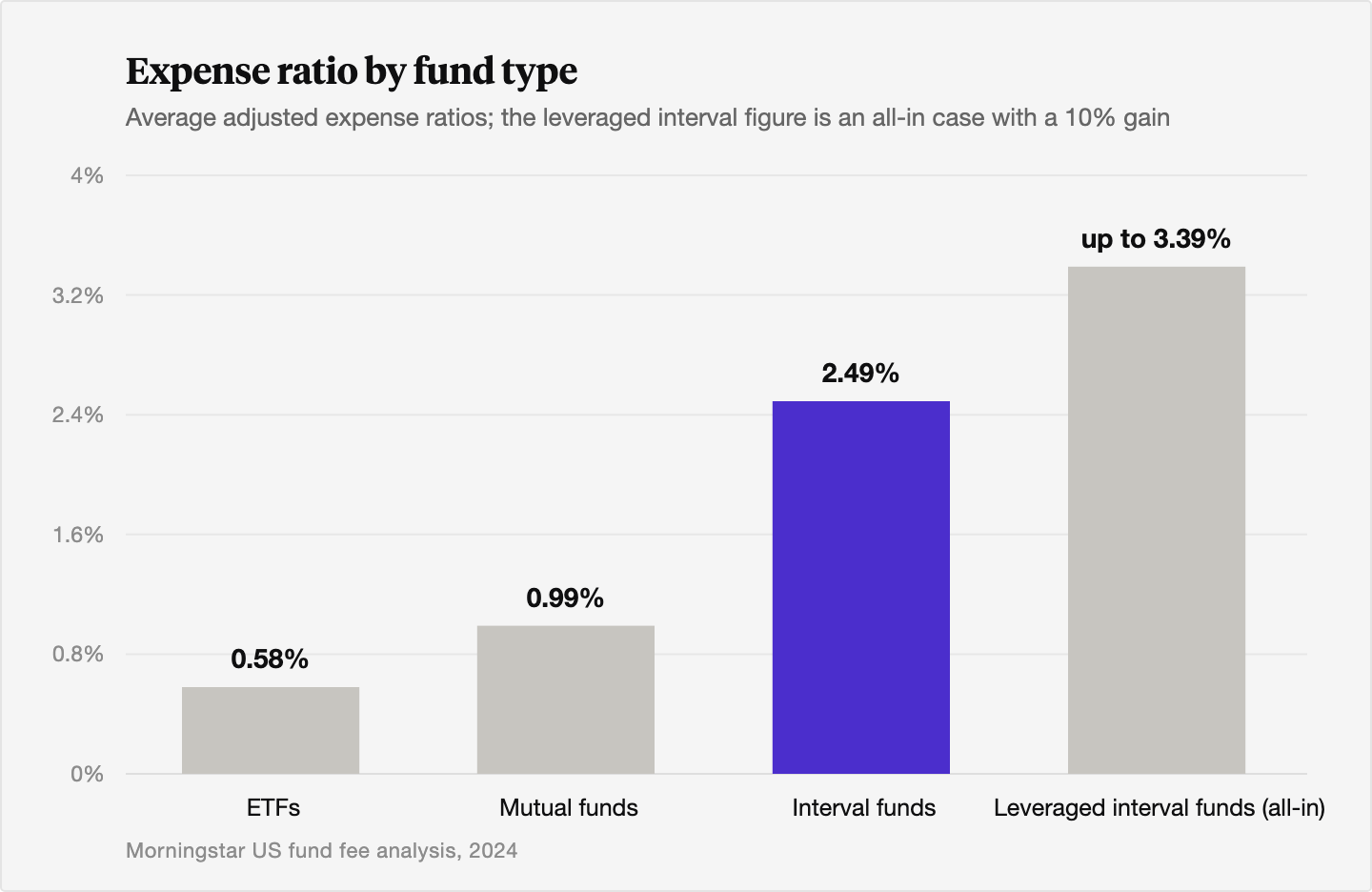
- You pay for the access. Morningstar's review of fund prospectuses put the average interval fund expense ratio at 2.49%, against 0.99% for the average mutual fund and 0.58% for ETFs [5]. Private holdings are expensive to value and manage, and that cost lands in the ratio.
- The category has grown fast. The Investment Company Institute counted 148 interval funds holding about $131 billion in assets at year-end 2025, with the broader semi-liquid category, including tender-offer funds, running into the hundreds of billions [6][7]. The growth is real, and so is the concentration in private credit and real estate.
- It is one wrapper among several for illiquid assets. Interval funds, private drawdown funds, and securitized routes like Regulation A+ fractional art all solve the same problem, getting retail capital into assets that do not trade daily. They sit at different points on the liquidity and access spectrum. We cover that comparison near the end.
1. What an interval fund actually is
Start with the plumbing, because the name describes it. An interval fund is a closed-end fund. It does not redeem shares on demand the way an open-end mutual fund does every business day. Instead it commits, as a fundamental policy in its charter, to make repurchase offers at fixed intervals [3].
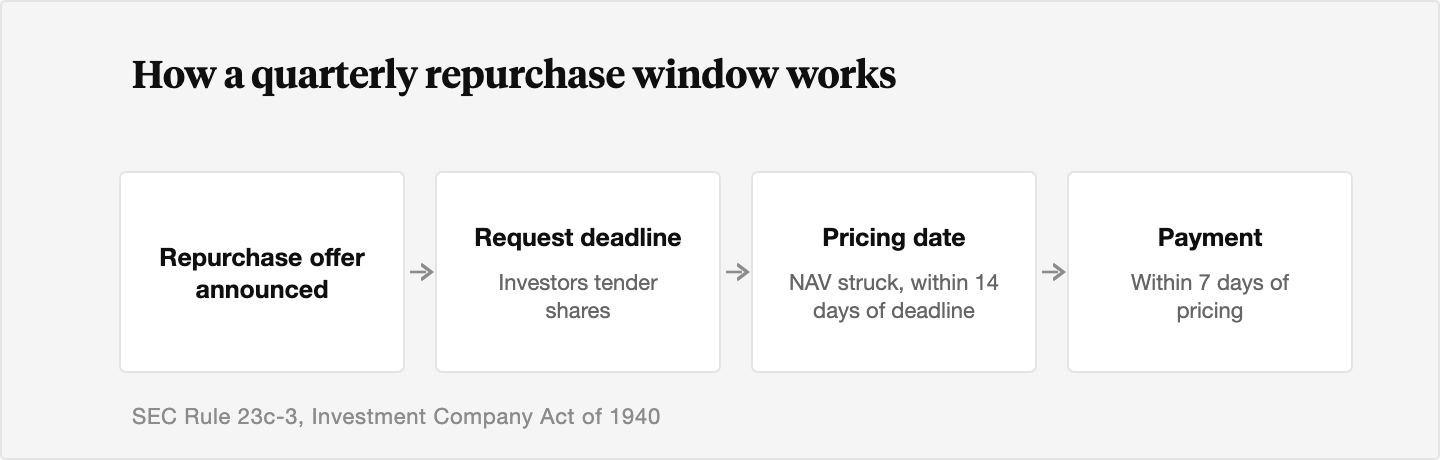
Here is the worked example. Imagine you own $100,000 of an interval fund that runs a 5% quarterly repurchase policy. Once a quarter the fund announces an offer to repurchase 5% of its outstanding shares at the NAV struck on the repurchase pricing date. You decide how much, if any, to tender. The pricing date falls no later than 14 days after the request deadline, and the fund pays you within seven days of that pricing date [3]. If you do nothing, you stay invested and wait for the next window.
The "fundamental policy" part matters. Under Rule 23c-3 the repurchase commitment is written into the fund's governing documents, and changing it requires a majority vote of shareholders [3]. The fund cannot quietly suspend redemptions in a bad quarter, which is a real protection. What it can do, and will, is hold you to the size limit of the offer.
2. The 5% rule and why liquidity is genuinely limited
The repurchase amount can be set anywhere from 5% to 25% of shares per offer [3]. In practice most funds choose 5% quarterly, which works out to a theoretical maximum of about 20% of the fund redeemable in a calm year. That ceiling is the point of the structure, and it is also its main risk.
Consider what happens when redemption requests run hot. If shareholders ask to sell more than the 5% on offer, the fund does not fill everyone in full. It fills requests pro rata [1]. A fund may raise the offer by up to 2% to absorb a modest oversubscription without going pro rata, but beyond that you get a haircut [3]. Say you and other investors collectively ask to redeem 12% of the fund in a quarter where 5% is offered. Each request is filled at roughly the same fraction, so you might recover well under half of what you tried to take out, and you queue again next quarter for the rest.
That is the trade. You are buying exposure to assets that do not trade daily, so the wrapper around them cannot offer daily exits. In a stressed market, when you most want out, the line is longest and the pro rata cut is deepest. We think investors should size an interval fund position as money they can leave alone for years, not as a near-cash holding.
3. Who can buy one, and the minimums
This is where interval funds break from most private market vehicles. If an interval fund registers its shares under the Securities Act of 1933, it can sell to the public, including investors who are not accredited [4]. The accredited standard, broadly a $200,000 income or $1 million net worth threshold outside a primary home, gates most private funds. Many interval funds do not require it.
Minimums are modest by private market standards, often in the $1,000 to $25,000 range depending on the share class [4]. There is a fee wrinkle tied to investor type. A retail interval fund open to non-accredited investors generally cannot charge a performance fee in the usual private fund form, only a fulcrum fee that adjusts up and down with results, while a fund that charges a straight performance fee must limit itself to accredited investors [4].
So the access story is the headline. An interval fund can put private credit or real estate strategies in front of an investor with $10,000 who would never clear the gate at a traditional private equity fund. The catch arrives in the next two sections, on fees and on the alternatives.
4. The fees, stated plainly
Interval funds cost more than the index products most investors anchor on. Morningstar, reviewing the products' own prospectuses, found an average adjusted expense ratio of 2.49% across interval fund share classes, compared with 0.99% for the average mutual fund and 0.58% for ETFs [5]. With leverage and yield-based incentive hurdles layered in, Morningstar found the all-in figure can reach 3.39% in a year with a 10% gain [5].
Where does the money go? The holdings are the reason. Private credit and real estate positions have no daily public quote, so the fund pays third parties to value them, and active sourcing and management of private deals costs more than running an index [5]. On top of the management fee, you may see distribution and servicing fees, commonly 0.25% to 0.75% of net assets, and in some cases sales charges or repurchase fees that cover the administrative cost of the redemption window [1][8].
We are not flagging fees to scare anyone off. A fee is the price of a service, and for genuine private market exposure that an investor cannot assemble alone, a higher ratio can be reasonable. The discipline is to compare the all-in cost against the net return you expect from the strategy, and against what the same dollar would cost in a fund-of-funds structure, where layered fees can stack in a similar way.
5. Interval funds versus open-end mutual funds
The cleanest comparison is to the daily-redemption mutual fund most investors already know. The two share a registered, retail-friendly wrapper. They part ways on liquidity and on what they can hold.
An open-end mutual fund redeems every business day at that day's NAV, which is why it has to keep its illiquid holdings under a 15% cap [1]. Daily liquidity forces a liquid portfolio. An interval fund accepts limited liquidity precisely so it can drop that cap and hold a much larger slice in private assets [1]. That is the design choice in one sentence. Mutual funds optimize for getting your money back any day; interval funds optimize for getting you into assets a daily fund cannot touch.
The practical read for an investor: an open-end fund is the right wrapper when you may need the money on short notice and want broad, liquid market exposure. An interval fund earns its place only when you are deliberately reaching for the illiquid private exposure and can accept the quarterly window and the higher fee in exchange. For private credit, the fastest-growing corner of the category, the interval wrapper has become a common retail on-ramp.
6. Interval funds versus private drawdown funds
The other comparison is upmarket, to the traditional private fund. A classic private equity or private credit fund is a drawdown vehicle. It calls your committed capital in stages over a multi-year investment period, runs for a fixed life of roughly 7 to 12 years, and returns capital only as deals exit or the fund winds down [9][10].
An interval fund inverts most of that. It is evergreen, meaning it runs perpetually with no set end date. Your money is usually fully invested from day one rather than called over time, and your liquidity comes from the periodic repurchase window rather than from waiting on exits [9][10]. For an investor who does not want to manage capital calls or lock money up for a decade, that is a real convenience.
The cost of the convenience is twofold. First, fully invested day-one capital means you carry full market exposure immediately, with no measured pacing. Second, an evergreen fund holding a redemption buffer to honor its window may run a slightly more conservative book than a drawdown fund free to stay fully deployed, which can show up in return. Investors weighing the direct private equity route against an interval wrapper are really choosing between control and lockup on one side and convenience and a liquidity window on the other.
7. Where interval funds sit among routes into illiquid assets, including art
Step back, because the interval fund is one answer to a question that runs across all of alternatives. How do you get retail capital into assets that do not trade every day? Several wrappers compete to solve it, and they line up on a spectrum from least liquid to most.
At the illiquid end is the private drawdown fund: a decade-long lockup, capital calls, exit-driven distributions, accredited or qualified investors only. In the middle sits the interval fund: broadly available, fully funded up front, with a periodic repurchase window at NAV that offers limited and pro-rated liquidity. Toward the more accessible end are securitized retail routes built on the Securities Act, including fractional or securitized art offered under Regulation A+.
Art is a useful case because it is one of the most illiquid assets there is, with low turnover and no daily market. Securitized art platforms register offerings under Regulation A+ of the Securities Act, which lets non-accredited investors buy fractional shares in an individual work [11]. Some platforms then run a secondary market where members can trade those shares with one another, typically after a holding period, which adds a liquidity option that the underlying asset, a single painting, does not have on its own [12]. That liquidity is not guaranteed. It depends on finding another investor willing to buy, and a seller may have to hold until the work itself is sold [12].
The comparison is instructive rather than identical. An interval fund offers liquidity through the fund's own balance sheet, the fund itself stands ready to repurchase up to its offer amount at NAV. A fractional art secondary market offers liquidity through other investors, the platform matches a buyer to a seller and does not itself promise to buy. Both are partial answers to the same illiquidity, and both carry the honest caveat that the exit can narrow exactly when demand to sell is high. Past performance of any of these structures is not predictive of future results, and each carries risk of loss of principal.
For investors thinking about art as an alternative allocation, the interval fund is a helpful reference point. It shows what a regulated, retail-accessible wrapper around illiquid assets looks like, what it costs, and where its liquidity has real limits. Those same questions, access, fees, and the true shape of the exit, are the right ones to ask of any route into a market that does not trade daily.
The Bottom Line
- An interval fund is a closed-end, SEC-registered fund that offers to repurchase a fixed share of its assets at NAV at set intervals, usually 5% per quarter under Rule 23c-3.
- The structure exists to hold mostly illiquid private assets while still giving investors a periodic exit, which a daily-redemption mutual fund cannot do.
- Liquidity is genuinely limited. If redemption requests exceed the offer, you are filled pro rata and may recover only part of what you asked for, so size the position as long-term money.
- Most interval funds are open to non-accredited investors at modest minimums, but they cost more, with an average expense ratio near 2.49% against about 0.99% for mutual funds.
- Compared with a private drawdown fund, an interval fund trades lockup and capital calls for convenience and a liquidity window. It is one wrapper among several, including securitized art under Regulation A+, for reaching illiquid assets.
Sources
- FINRA. "Interval Funds: 6 Things to Know Before You Invest." FINRA.org, accessed June 2026. https://www.finra.org/investors/insights/interval-funds
- FINRA. "Interval Funds" (investor notice). FINRA.org. https://www.finra.org/sites/default/files/NoticeDocument/p003999.pdf
- ACA Group. "Rule 23c-3 for Interval Funds: An Overview." acaglobal.com, accessed June 2026. https://www.acaglobal.com/industry-insights/overview-interval-funds-rule-23c-3/
- Cohen & Co. "Interval and Tender Offer Funds: 5 Q&As to Better Understand Their Benefits and Challenges." cohenco.com, November 2024. https://www.cohenco.com/knowledge-center/insights/november-2024/benefits-and-challenges-of-interval-and-tender-offer-funds
- Morningstar. "5 Things You Need to Know About Interval Fund Fees." morningstar.com, accessed June 2026. https://www.morningstar.com/funds/5-things-you-need-know-about-interval-fund-fees
- Investment Company Institute. "A Guide to Closed-End Funds" and 2025 Investment Company Fact Book data. ici.org, 2025. https://www.ici.org/cef/background/bro_g2_ce
- Interval Fund Tracker. "Interval Funds Monthly: December 2025." intervalfundtracker.com, January 4, 2026. https://intervalfundtracker.com/2026/01/04/interval-funds-monthly-december-2025/
- Interval Fund Tracker. "Understanding Interval Fund Fees and Expenses." intervalfundtracker.com, accessed June 2026. https://intervalfundtracker.com/2023/08/18/interval-fund-fees-and-expenses/
- Blue Owl Private Wealth. "A Primer on Drawdown and Evergreen Funds." wealth.blueowl.com, accessed June 2026. https://wealth.blueowl.com/learnengage/bo/evergreen-vs-drawdown-funds
- CAIS. "Comparing Private Market Fund Structures: Evergreen vs. Drawdown." caisgroup.com, accessed June 2026. https://www.caisgroup.com/articles/the-potential-trade-offs-of-private-markets-fund-structures-part-two
- Masterworks. "Understanding Fractional Art Investing." insights.masterworks.com, accessed June 2026. https://insights.masterworks.com/alternative-investments/art-investing/understanding-fractional-art/
- Masterworks. "Learn to Invest in Fine Art: Trading." masterworks.com, accessed June 2026. https://www.masterworks.com/about/trading
Disclosures
Investing involves risk. Past results are not indicative of future outcomes.
Masterworks is providing this communication as an agent for its issuer entities, not Masterworks Advisers. This material is produced by Masterworks for informational purposes only and does not constitute investment advice, a recommendation, or an offer or solicitation to buy or sell any security. Masterworks is not a licensed broker-dealer by the SEC or FINRA.
Masterworks can only make and accept sales after an offering statement has been filed, and "qualified", by the SEC. Any offers may be revoked before notice of qualification. Indications of interest involve no obligation. For further disclosure visit the offering documents filed with the SEC and Important Disclosures at masterworks.com/cd.
Forward-looking statements and internal estimates are based on assumptions that may prove incorrect, and actual outcomes may differ materially. Figures denoted in brackets are subject to confirmation. Investing in art and alternative assets involves risk, including loss of principal.
Art sales price data is comparative only. Each painting is unique and historical data is not a direct proxy for any specific painting or investment. Data represents whole art, not an investment into our offerings which includes fees and expenses. Any comparative images are not currently live offerings and are provided for educational purposes only.
Masterworks, LLC is located at 1 World Trade Center, 57th Floor, New York, NY 10007.


